Applied Topics: The Network Collapse
This lecture explores Multiple Sclerosis (MS) through the lens of network science, moving beyond simple lesion counts to explain why some patients experience severe symptoms while others remain relatively stable. The lectures detail how the brain attempts to compensate for structural damage through "functional reorganization," where regions work harder to maintain performance. However, this compensation has limits; the lecture introduces the concept of "network collapse," a threshold at which structural and functional damage becomes severe enough to cause cognitive decline, slower processing speeds, and a loss of network flexibility. By integrating structural MRI, functional MRI (fMRI), and magnetoencephalography (MEG), the lecture illustrates MS as a progressive "rerouting" of brain function that eventually becomes inefficient.
Learning objectives:
By the end of this lecture, students will be able to:
- Understand the "Clinical-Radiological Paradox":
- Identify the theoretical threshold where the brain’s ability to compensate for damage fails, leading to accelerated decline
- Recognize the importance of the thalamus as a "barometer" of early damage and the cortex as a predictor of late-stage progression
- Understand how "resting state networks," particularly the Default Mode Network (DMN), change in MS patients
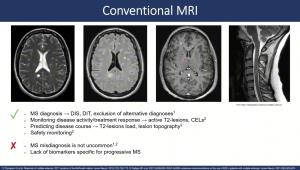
- Pathology and MRI Correlation
- The Thalamus as a Hub
- Functional Reorganization
- Default Mode Network (DMN) Dysfunction:
- Advanced Imaging Modalities
- Energy and Switching Costs
- PIRA and Smoldering MS