A Brief Overview
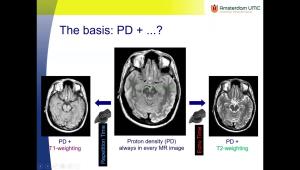
This lecture provides a foundational overview of Magnetic Resonance Imaging (MRI), explaining the physical principles of magnetization, resonance, and spatial localization. The session describes how strong magnetic fields align nuclear spins to create microscopic magnetization, which is then manipulated using Radio Frequency (RF) pulses to generate a measurable signal. Furthermore, it explains how gradient magnetic fields encode spatial information by varying precession frequencies across different locations, enabling image reconstruction via Fourier transforms. The lecture concludes by demonstrating how these principles are applied to create various clinical contrasts, such as T1- and T2-weighted images, which help distinguish tissue types and pathologies, including tumors.
Learning objectives
By the end of this lecture, students will be able to:
- Understanding of the basics of MRI
- Basic contrast and image formation in MRI
- Relaxation concept of MRI and how to use it in forming an image
- Behavior of the spin under magnetization and manipulating these spins with a magnet
- What is the main magnetization?
- What is a gradient field?
- What is an RF pulse?
- What is the transverse and longitudinal magnetization?
- How do we obtain contrast using transverse and longitudinal magnetization?
- Echo Time, Repetition Time