Basics of MRI
Introduces the fundamentals of MRI, covering the basic physics and imaging techniques
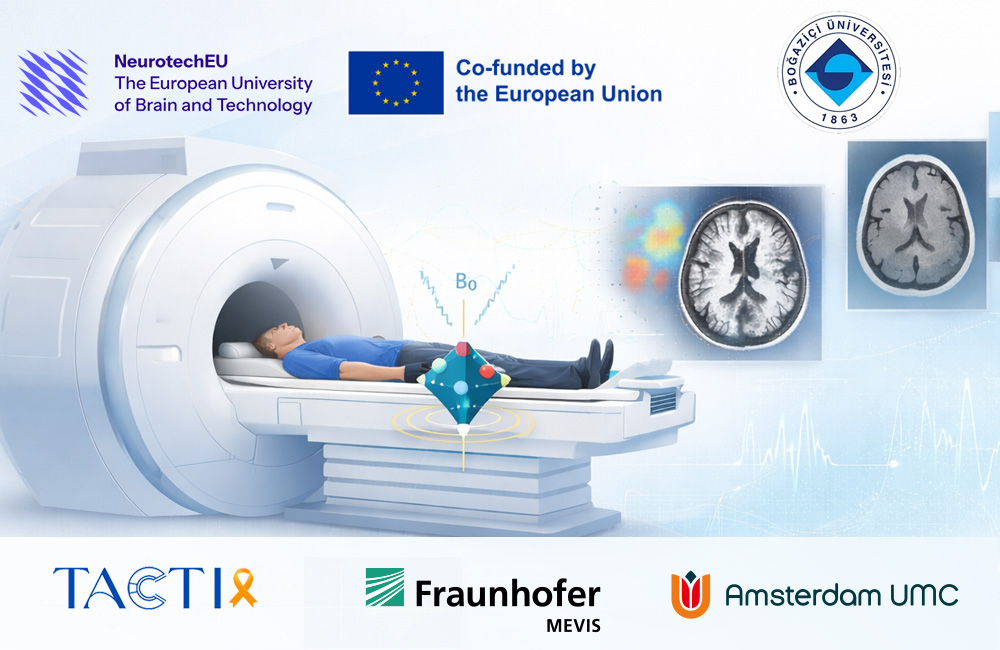
This course introduces the fundamentals of MRI, covering the basic physics and imaging techniques. Through twelve expert-led lectures by Matthias Günther and Joost Kuijer, participants will gain a foundational understanding of how MRI works. Possible topics: magnetization, relaxation, quantum mechanics, signal detection and acquisition, Fourier imaging, image reconstruction, contrast, signal, and noise, water-fat separation, steady-state gradient-echo imaging, echo-planar imaging, hardware issues, fast/parallel imaging. The course also covers how MRI contrast mechanisms work and how they are used to form different MR images. This course includes a live demo session on the MevisMRLab tool, an MR simulation tool designed to better understand the concepts covered throughout the course. By the end of the course, participants will have a clearer understanding of MRI fundamentals and its underlying principles.
This course collection is offered as part of the TACTIX project in collaboration with Boğaziçi University, Amsterdam UMC and Fraunhofer MEVIS.
Target Audience: Graduate students, researchers, radiology technicians, and medical doctors with an interest in understanding the fundamental principles of MRI.
Basic understanding of physics and algebra. No prior MRI knowledge needed
Lessons
Number of lessons: 4-
Matthias Günther
This lecture provides a foundational overview of Magnetic Resonance Imaging (MRI), explaining the physical principles of magnetization, resonance, and spatial localization. The session describes how strong magnetic fields align…
-
Joost Kuijer
This lecture provides a foundational overview of how magnetic resonance imaging (MRI) manipulates proton behavior to create diverse tissue contrasts. The lecture explains that while other imaging modalities like CT have fixed…
-
Joost Kuijer
This is the second part of the previous lecture, and it explores the technical and clinical nuances of MRI signal encoding and advanced contrast mechanisms. The lecture begins with a focus on spatial encoding, explaining how…
-
Matthias Günther
This lecture introduces a graphical MR teaching tool, MevisMRLab, that helps students understand MRI physics by allowing them to build and simulate their own pulse sequences. The tool features a sequence diagram for manipulating…